gh-reloaded
Full-width board
On a GitHub Projects Board (kanban) view, stretches the board to the full window width instead of sitting inside the page’s normal centered, padded column — more room for columns before they need to scroll horizontally.
On by default (unlike Board dependency arrows, which is opt-in). No in-page control — this is a layout default you either want or don’t, toggled once from Settings, not something to flip per session.
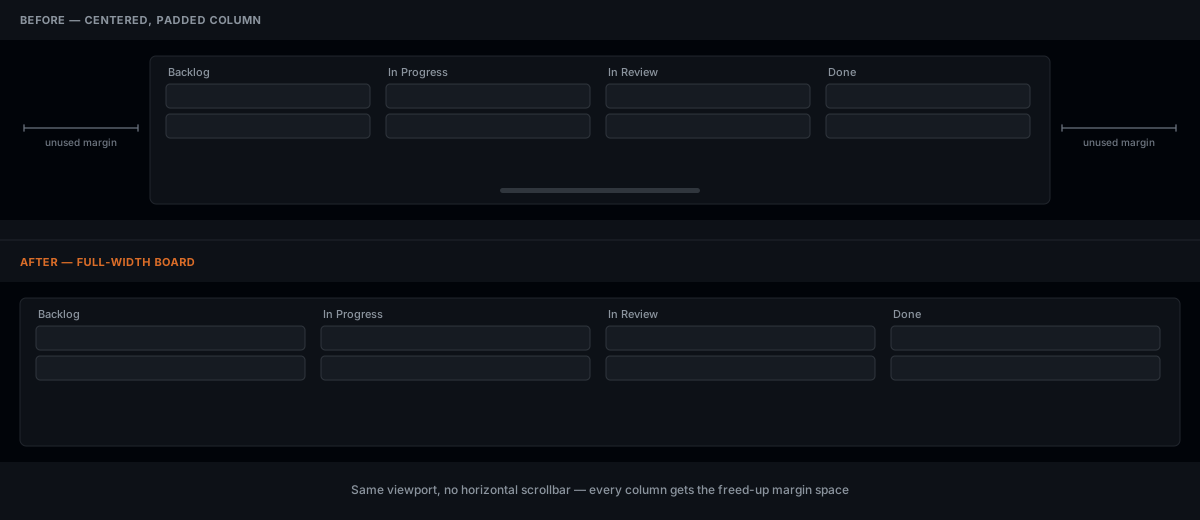
Mockup illustrating the layout — not a literal screenshot.
What it does
- Detects a Board view the same way Board dependency arrows does (the selected view tab’s own icon), and while enabled:
- Stretches the board’s own container to reach the viewport’s right edge, starting from wherever it actually sits — measured live off its own
getBoundingClientRect()rather than assumed via a fixed viewport-centered offset, since a slice-by panel (or anything else occupying real space to the board’s left) would otherwise throw that assumption off. AResizeObserveron the slice-by panel keeps the measurement live while it’s dragged wider or narrower. - Zeroes out the columns row’s own
min-width(GitHub sets it inline, computed as columnCount × each column’s configured width — sized to always fit every column at full width no matter how much room the page actually gives it) and turns each column into a flexible, shrinkable flex item with a 150px floor, instead of a fixed-width one. - Keeps narrow boards legible: a column title stays on one line and ends in “…” with the full title and count in a tooltip, the “…” menu never shrinks, and when a title would get fewer than about six characters the count badge hides first. Card labels end in “…” and the title wraps, so nothing spills out of the card.
- Sizes the column-header row and each swimlane header to the width of the columns, so a lane header ends with the last column and scrolls with it. If a board scrolls lane by lane instead, each header is sized to its own lane and its label stays at the lane’s left edge.
- Lines the first column up with the view tabs and filter bar (the gutter is read from the view tabs) and keeps the last column the same distance from the window edge with or without a scrollbar.
- Stretches the board’s own container to reach the viewport’s right edge, starting from wherever it actually sits — measured live off its own
Known limitations
- Column shrinking has a 150px floor per column — a board with enough columns that they’d need to go narrower than that to all fit keeps a (smaller) horizontal scrollbar, same as without this feature, just later.
- Targets class names (
boardContainer__,horizontalGroupAreaContainer__,ColumnFrame__,SlicerPanel__, …) read off a live board’s DOM. GitHub’s Projects app (internally “memex”) doesn’t publish stable class names — CSS-module hashes regenerate on every deploy, and in 2026 GitHub also dropped the file prefix (Board-module__boardContainer__xbecameboardContainer__x). The selectors match the local name followed by__(the current naming) and also list the previous<file>-module__<name>form as a fallback, so both generations work;test/unit/module-classes.test.jschecks that every fallback sits next to its current form. - Forcing columns to a different width than GitHub itself computed could visually glitch mid-drag if you resize or reorder a column while this is active — GitHub’s own drag-and-drop math is built around its own configured widths, not this override.